
Since the advent of our species, humans have been preoccupied with the question of what can be classified as “real” and what can not. Equipped with the shocking revelations of the Epstein-files and the swift advancements of generative AI on top, the 21st century begins to have our self-image as rational and civilized beings in a chokehold.
The age of photographic evidence has come to an end. Innocently titled AI-tools like “Nano Banana Pro” have recently put the final nail in the coffin. Before you know it, you might see yourself committing a crime you never even thought of; in pristine 4K, naturally. Suddenly everything seems possible. Or perhaps possibly truthful?
Coinciding with these developments, the long-awaited release of the “Epstein-Files” by the Department of Justice in the United States is leading well-adjusted citizens to doubt the very fabric of the reality, which they – we – once took for granted.
Jeffrey Epstein, a man with a seemingly inexhaustible amount of contacts, power and influence, moved through the upper ranks of society with casual ease. By help of an absurdly, inexplicably large amount of wealth at his fingertips, he was able to afford a generous amount of downtime; during which the writing of e-mails and phone messages never came to a halt. Conversing with the likes of Steven Bannon, Elon Musk, Harvard professor Martin Nowak and other individuals whose names have been redacted, exchanges circled around image management, contemporary politics and facilitating sexual encounters with oftentimes underage individuals.
All of this was widely suspected – and to a certain extent known – before the files were released to the public. Nonetheless, the depth of the depravity still manages to shock. During multiple correspondences, Epstein and his “customers” utilise key-words such as “cream cheese”, “pizza (party)” and “grape soda”, which allegedly function as codewords or euphemisms for the physical violation of minors and babies.
Accelerated Immersion through Social Media
Users on text-based platforms such as Reddit went a step further and tried connecting the wording of Epstein’s mails to the refuted Pizzagate-conspiracy theory from ten years ago, which claimed that Hillary Clinton and high-ranking Democrats ran a child sex trafficking ring out of the basement of Comet Ping Pong, a D.C. pizza parlor. While the theory has turned out to be nothing but an internet fever-dream, the narrative eventually evolved into the QAnon movement and due to the similar “food code” claims, has now once again resurfaced. Some theorists on Reddit even state that they believe Epstein might have been Q himself. It only gets more “off-the-rails” from here: Epstein didn’t actually die in prison, his corpse was swapped out right before he was picked up. The ultimate full-circle moment is achieved when users see themselves proven right in their theories that a Jewish-imposed world order is real, due to the simple fact that Epstein himself was Jewish.
On the platform of Instagram, a different process is taking place altogether. Due to the released documents describing horrific acts, which in some cases border the sphere of the ungraspable, the collective cultural consciousness copes not by suppressing the available information but by initiating a transition to a more easily digestible version of it. This includes creating comparatively lighthearted memes about “summer days with the bros” – for example – featuring imagery from the released files showing Epstein in summer attire at the beach or in one of his many estates. The deceitful normality on display heavily clashes with the context these photos were taken in, serving as a backdrop to unspeakable atrocities.
Falsehoods aren’t a rarity here either, though. Multiple widely-spread videos show images of an e-mail correspondence between Epstein and Musk, in which the latter proclaims interest in coming down to Epstein’s island for an “epic vacation” only to swiftly get shut down by Ghislaine Maxwell, Epstein’s number one confidant. In the comment sections below the videos and reels it quickly becomes evident that a large sum of users are not aware of the fact that they are looking upon doctored mails.
But does it really matter?
The tone of the correspondence successfully captures that of thousands of other authentic ones; casual, littered with spelling mistakes and obscure references. Due to the Epstein-files marking a culturally significant moment, these fabrications are nothing more than an extension of a truth revealed at last. A symptom of a Zeitgeist without clear falsehoods; a world built on the ubiquity of conspiracy.
Subjective Truth as the Universal Remedy for a Discontent Society
Furthermore, the international political arena – which suffers under the wrath of expansionist regimes from multiple continents – has revealed itself to be at risk of collapse. The great amount of existential anxiety generated and unleashed upon the public by news cycles of the last months is not to be underestimated. In true Orwellian fashion, citizens are best advised to “reject the evidence of their eyes and ears” to keep on feeding their minds the sweet little lies it needs to prioritize individual well-being. If we now add the advancements in AI-research and the release of files exposing large swaths of the upper echelons of society as predatory criminals to the blender, you got yourself one hell of a cocktail! Are we on the brink of arriving in a “post-truth” era or have we already entered it?
Are the photos my friend keeps showing me of his new girlfriend real or not? Does she exist? Or is it real but just not in the sense of what “real” used to mean?
It‘s kind of hard to tell.
Is Epstein alive? Does Putin possess evidence of Trump violating kids? Are there secret tunnel systems below New York City?
Just a few blue moons ago, these seemingly absurd, problematic and utterly ridiculous claims were perceived to only be worthwhile to conspiracy-fetishists. Unfortunately, the epistemological validity of such narratives isn’t the primary – or even secondary – concern anymore. The construction of new, alternative strands of truth prohibit the acceptance of one, “objective” reality. Which is rather worrying to say the least. Will all of this still be relevant in a few years?
It’s kind of hard to tell.
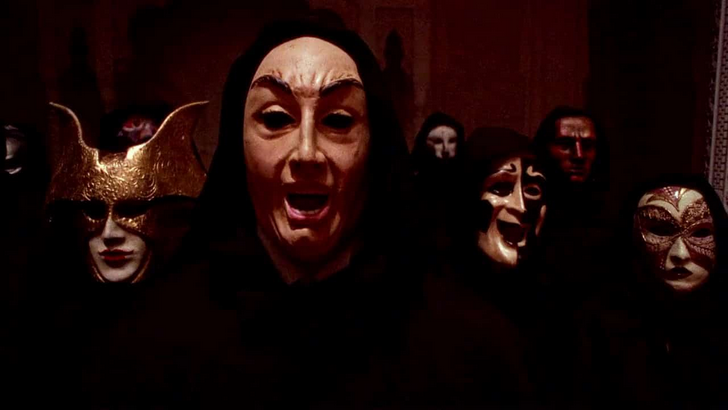
Foto: Filmstill aus Stanley Kubrick‘s „Eyes Wide Shut“ (1999)